
CARIFESTA- its symbolism, history, development
This is one in a series of articles, photographs and videos from our archives that we will share over the next few weeks as we continue the countdown to CARIFESTA XII in Port-au-Prince, Haiti, 21-30 August. The pieces will showcase our multi-faceted cultural heritage, the faces and the voices of our icons, our people.
First published in the CARICOM Secretariat Publication, CARICOM View CARIFESTA…a homecoming! (Volume 4 Issue 1/2008)
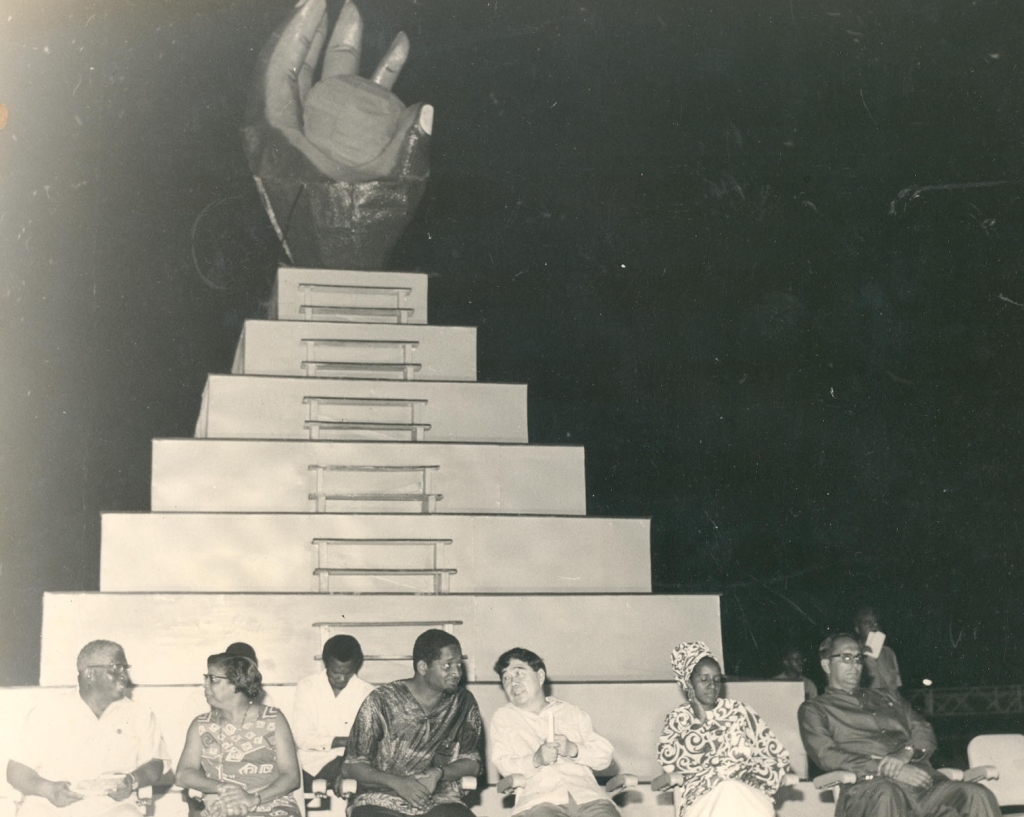
The Caribbean Festival of Arts (CARIFESTA) is an exhibition of the diverse cultures of the countries and islands that are washed by the Caribbean Sea.
This Festival is a progeny of several initiatives that were aimed at stimulating regional integration. The celebration of Caribbean arts hosted by Puerto Rico in 1952, the 1958 British West Indian Federation and the Caribbean Free Trade Area (CARIFTA) of 1965, were all precursors to the roving, multidisciplinary, mega exposition of Caribbean cultures.
It should not go unnoticed that the earliest festival which exhibited the Caribbean way of life was held in the unincorporated American territory, Puerto Rico. Very often when reference is made to the Caribbean, ideas of the British West Indian territories obscure the fact that this hemisphere is made up of a rich array of cultures and people from geopolitical backgrounds including the English, French, Dutch, and Spanish.
Historical symbolism
While each Caribbean state brings its own uniqueness to this melting pot of civilisation, the migration of the indigenous people here, slavery and colonialism belong to all of our pasts.
Against this historic backdrop, CARIFESTA should not be viewed as a grand one-off fete, but as a commemoration of the extraordinary survival of a people and their way of life through the dehumanising systems of imperialism.
Colonisation, in particular, played a significant role in the evolution of the Caribbean culture. Many of the practices that now signify our way of life were created through assimilation of imperial structures, infused with residual strains of ancestral traditions of the peoples who were transplanted to this Region.
The region’s writers have long meditated on the Caribbean’s fragmented identity. In his Nobel Prize acceptance speech in 1992, Saint Lucian-born Derek Walcott described the residues of ancestral tradition in the Caribbean culture as “partially remembered customs…memory that yearns to join the centre, a limb remembering the body from which it has been severed.”
This theme of fragmentation of the Caribbean psych was further explored by Trinidadian writer V.S. Naipaul in his Novel `The Mimic Men’. His main character, Ralph Singh, is a microcosm of the displaced and disillusioned colonised Caribbean, which struggles to reconstruct its identity to get rid of the crippling sense of fragmentation in the post-colonial era.
According to Barbadian-born, George Lamming, in the introduction to his novel `In the Castle of My Skin’, British colonialism created a fragmented society, one that was torn between the desire to emulate the “mother” country and the need to establish an independent existence. He described this dichotomy as a “deep split in its sensibility which now raises difficult problems of language and values.”
While the foregoing suggests that slavery and colonialism have tremendously affected the Caribbean’s prospects of establishing a sense of belonging and identity in the post-colonial era, they have inadvertently added much significance to CARIFESTA, establishing a basis for it to be seen as a celebration of the restoration of our fragmented histories and an assertion of our distinctiveness.
Literature’s link to CARIFESTA is inseparable,and has been an important component of the festival’s activities from the very inception. Not only has it been a vehicle for cultural transmission, but Caribbean authors such as Walcott, Martin Carter, Wilson Harris, George Lamming, V.S. Naipaul, David Dabydeen Jean Rhys, among others, have been at the forefront of stoking the cultural sensibilities of the Caribbean.
Beginnings

The idea of a festival to promote the arts was promoted by a number of Caribbean writers and artists, who were involved in activities Guyana hosted in the latter 1960s into the early 1970s, to celebrate its release from the umbilical cord of the ‘motherland’. Martin Carter and George Lamming were among the writers who put forward the idea to Guyana’s then Prime Minister, Forbes Burnham, to begin a Caribbean Arts Festival. Their idea was supported by Prime Minister Burnham, who offered to host the event in Guyana from August 25 to September 15, 1972, under the theme `The Artist in Society with Special Reference to the Third World’.
The logo for the first CARIFESTA was “a dark hand rising, grasping the sun, depicting the skills and aspirations of the tropical man with talent untold”, a fitting symbol of the Caribbean people defining themselves and articulating their aspirations. Among the objectives of the inaugural Festival was to “depict the life of the people of the Region, their heroes, morale, myth, traditions, beliefs, creativeness, and ways of expression”.
CARIFESTA II was held four years later in Jamaica, July 23- August 2; followed by Cuba in 1979; Barbados, 1981; Trinidad and Tobago, 1992 and 1995; St. Kitts and Nevis, 2000; Suriname, 2003, and again in Trinidad and Tobago in 2006.
New Strategic Direction
Efforts have intensified to engineer a new strategic direction for CARIFESTA with a view to positioning it as a world-renowned mega festival of Caribbean cultural and artistic excellence that brings economic benefits, unites the region and excites all people.
The recognition that CARIFESTA needs to become a viable enterprise is coupled with the acknowledgement that it has made vital contributions to the development of cultural infrastructure in the Region. Therefore, the idea is not to reinvent the wheel of the Festival but to improve existing structures and incorporate contemporary management techniques to derive the highest potential benefits of CARIFESTA to the Region.
The key objectives of the Strategic Plan are grouped into categories described as “three critical success factors”: Operational Excellence, Market Leadership and Stakeholder Interest.
According to the Plan, operational excellence focuses on the staging of quality performances that would attract the widest possible audience from the Region and the Diaspora. Sound event management and economic impact assessment are two additional areas to be addressed.
Marketing leadership encompasses rebuilding the brand identity and image of the Festival through sound event management strategies. It proposes greater collaboration with key stakeholders including the media, host and sending countries, artistes and art organisations, and corporate sponsors in the tourism industry with the aim of advancing the economic benefits of the Festival among these key players, to encourage their full involvement.
The all-encompassing Strategic Plan to remodel CARIFESTA would be implemented in phases, according to the CARICOM Secretariat Deputy Programme Manager for Culture and Community Development, Riane De Haas-Bledoeg. She noted that there were some challenges with regard to funding but arrangements were fully operational with the Interim Festival Directorate acting in an advisory capacity during this transitional period and providing critical monitoring of intellectual property rights issues such as the permanent CARIFESTA Logo.
Further, the CARICOM Secretariat has recruited a Legal Consultant who has been providing advice and support to the Secretariat in the implementation of the new CARIFESTA management structure. Based on an analysis of the legal and intellectual property issues related to the new model proposed for CARIFESTA, the Consultant is expected to advise on the best approach to develop the new CARIFESTA structure to derive maximum benefit from the Intellectual Property value of the Festival. Infringement matters related to CARIFESTA, including the domain name and use of the CARIFESTA name, are also to be examined by the Consultant.
CARIFESTA TEN: A HOMECOMING
Four years after the new model of CARIFESTA was approved by the Conference of Heads of Government, it was expected that more innovative elements would have been implemented during CARIFESTA X than the preceding Festival. There are five noteworthy features of the new face of the Festival that would be evident at CARIFESTA X.
One of the key changes the Plan proposed was that the Festival should be held every two years to transform CARIFESTA into a hallmark event. That has begun, according to Dr. Hilary Brown, Programme Manager, Culture and Community Development, CARICOM Secretariat.
After a five-year break between 1995 in Trinidad and Tobago and 2000 in St. Kitts and Nevis, there was an emergence of a more sequential pattern with a three-year gap between the following two CARIFESTAs: 2003 to 2006, and a two-year gap between the last edition in Trinidad and Tobago and the Guyana homecoming in 2008.
With the proper sequencing of the Festival on stream, action is now being taken to ensure that CARIFESTA promotes development in cultural industries.
Dr. Brown explained that one of the development aims of CARIFESTA was to secure the expertise of renowned arts developers and presenters from the United Kingdom, Canada, and the United States, to come to CARIFESTA and network with Caribbean artistes. She added that this move was to create opportunities for bookings and tours for Caribbean artistes to perform internationally, an important development for the cultural industry, which CARIFESTA would enable in keeping with its new strategic direction.
One of the 12-point objectives of the Plan states that there should be collaboration with the media “in the design of the programme to ensure widest possible access to terrestrial TV, cable, radio, and Internet.”
In this regard, greater coverage from the international media was evident during CARIFESTA X. For the first time in the history of CARIFESTA, the opening and closing ceremonies were broadcast live on the Caribbean Media Corporation (CMC).
Involvement of the Diaspora

While the Strategic Plan did not design a method to mobilise the involvement of the Diaspora, Dr. Brown noted that it was in keeping with the overall development of the Festival. And there was interest in the Diaspora for CARIFESTA X.
Perhaps one of the critical instruments that helped to stimulate the interest of the Diaspora was the CARIFESTA X website. The utilisation of Information Communication Technologies (ICTs) and Internet technologies to maximise access and broadcast coverage was proposed in the Plan to enhance the marketability of the Festival. The CARIFESTA X website was replete with information pertaining to the history of the Festival, the preceding nine editions of CARIFESTA, publications and press releases, and additional information regarding the planning of CARIFESTA X.
Professor at the School of Media Arts, Ohio University; Guyanese-born Professor Vibert Cambridge told the CARICOM View that the involvement of the Diaspora in CARIFESTA X came from New York, Toronto, and the United Kingdom.
Professor Cambridge revealed that in 2007, the members of the Diaspora began to utilise their international networks to mobilise the participation of Caribbean artists and literary icons in CARIFESTA X.
According to Professor Cambridge, prior to the Festival, the Diaspora’s support included several public relations activities including an internet blog, which was aimed at generating interest in attending CARIFESTA X in Guyana.
In addition, he said that technical assistance was provided to performing arts venues in Georgetown such as the Theatre Guild and the National Cultural Centre. Further, the Diaspora contributed ideas for the fashioning of the CARIFESTA X Opening Ceremony as well as to the National Dance Company to improve its dance performances throughout the festival.
Professor Cambridge said that artists like Nalini Shaw, Taij Mottilall, Malcolm Hall, Clyde Duncan, Austin Clarke, Keith Waithe, Dorette Harper Wills and David Dabydeen added much depth to the Diaspora’s involvement in CARIFESTA X. He pointed out that Mr. David Dabydeen was very instrumental in Derek Walcott’s invaluable contribution the symposia and literary arts feature of the Festival.
Other notable highlights from the Diaspora’s involvement in CARIFESTA X, Professor Cambridge said included a Canadian dramatic performance on August 23, at the Theatre Guild entitled ‘Gravity’, and Keith Waithe’s exploration of Guyanese musical fusion. Keith Waithe, a renowned flautist, performed with ‘Buxton Fusion’, musicians who play traditional African and Indian instruments. Mr. Waithe also performed with the Surinamese drum and percussion group at the CARIFESTA X Opening Ceremony, and at many other venues during the Festival.
Professor Cambridge lauded the CARIFESTA X Secretariat for allowing the Diaspora to contribute to the Festival, which he said was significant to the development and sustenance of the arts.
CARIFESTA is especially significant to the history and development of the Caribbean culture. As the Festival returned to its first nesting place, a unique opportunity was created to engineer its re-emergence as the premier regional, roving, multidisciplinary Festival of Arts.